|
www.thepowerofcollectivewisdom.com
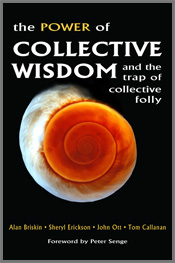
The Power of Collective Wisdom
and the Trap of Collective Folly
by
Alan Briskin,
Sheryl Erickson,
John Ott
&
Tom Callanan
(due
out October 2009)
Order Your Copy Now
via Amazon
via Berrett
Koehler Publishers
|
The
Power of Collective Wisdom is the result of a collaboration
involving dozens of contributors and hundreds of people from
our network and beyond. Stories fill the book, telling of
collective wisdom’s emergence in diverse settings,
across different cultures, and in earlier times. It also
sketches a larger worldview, one encompassing the reverence
for life associated with wisdom and the importance of a collective
perspective. Throughout the book, readers will be guided
toward a deeper understanding of the conditions that make
wisdom possible in groups and the characteristics that underlie
many successful group methodologies. Below are six stances
we believe help us prepare for collective wisdom’s
emergence.
Definition: A stance is an attitude and bearing involving commitment and conviction. These are choices of internal perspective and external action that we make in the day-to-day and moment-by-moment interactions we have with others. We believe a stance can be learned and practiced, becoming a new way of being in relationship with others, a new type of human association leading to unleashing the spirit of cooperation and unlimited cocreation in groups.
The stances are as follows:

“DEEP LISTENING”
Collective wisdom begins with a commitment to recognize that we are more than just the sum of our external parts. There is an interior realm within individuals, groups, and larger collectives. Deep listening invites us to be curious about what is really going on inside the person, the group, or the larger collective. It is an act of being fully present with others, not simply an act of hearing or memory. What do people really feel, dream, and fear? Deep listening is a way to pay attention to both interior and exterior worlds in order for groups to make sounder judgments and act in accordance with deeper values.
“SUSPENSION OF CERTAINTY”
A transcendent discovery is far more possible for individuals and groups when there is a willingness to risk, or admit, not knowing—when we confront directly the full weight of our confusion or the dilemma we are facing. The human capacity to make meaning together depends on a suspension of any one individual or subgroup’s having always to be in the right. This commitment to suspend certainty is what makes our knowing together collective, because something new and often unexpected emerges in and through the group. A greater collective wisdom becomes possible because ideas are no longer the possession of one person or subgroup, but are shared by those who helped shape it together. A suspension of certainty is akin to beginner’s mind, a commitment to not know in order for new knowledge to arise.
“SEEING WHOLE SYSTEMS/
SEEKING DIVERSE PERSPECTIVES”
This stance shifts our attention from the individual to the group. Each group member sees the world in a unique way, but all the information is valuable and part of the whole. Our diverse perspectives, therefore, matter because they reveal more of the whole system. This is why groups need to gather information from many perspectives: to increase their understanding of the whole. Committing to this stance requires us to find ways to synthesize diverse information, whether through multiple personal conversations, through data collection, or through group methodologies that emphasize listening and discovery.
“RESPECT FOR OTHERS/
GROUP DISCERNMENT”
Respect is a commitment to esteem others, even when disagreements arise. It is a willingness to recognize dissent as an avenue for new learning. Discernment is a capacity in groups for differentiation, permitting the emergence of new thinking and new images of what is possible. When respect and discernment are brought together, groups have a renewed ability to find common ground—even when such a direction seems difficult or obstructed. This commitment creates the conditions for alignment of personal, group, and higher-order values such as justice, compassion, and freedom. Although never perfect, this stance allows for the development of productive relationships and directed action in accord with a common purpose.
“WELCOMING ALL THAT IS ARISING”
How we invite others into relationship matters. The stance of welcoming brings conscious attention to how gracefully we treat each other—recognizing different needs, respecting differences, and celebrating our common humanity. It brings attention to sharing power with others and treating others as equals. This commitment also encourages us to welcome the pleasant and unpleasant aspects of group life, recognizing that even disruptive obstacles or difficult circumstances can be critical aspects of our passage to wholeness.
“TRUST IN THE TRANSCENDENT”
Underlying and critical to all the stances that aid collective wisdom’s emergence is a respect for human agency, the powers of nature, and the significance of a spiritual dimension to the activities we undertake. When we look out upon the world with awe and wonder, we are better able to see constructive possibilities rather than simply constricting limits. There is a Chinese expression that says when we step back, we can see more of the ocean and sky. Trust in the transcendent is the invitation to see a larger natural world on which the human journey is written. We become capable of remaining secure even in our uncertainty and better able to ask others for assistance, cocreating a world that works for all.
|
|